Research
nanomaterials -> neural interfaces -> biophysical theory
Current Interests
I study the statistical physics of biological ensembles and their interactions, focusing on RNA as a model system. I primarily work with Ofer Kimchi, Asst. Prof. of Mathematics at NYU's Courant Institute of Mathematical Sciences.
Biological interactions as random matrix ensembles
Interactions in biology are often visualized as circuits. The reality, however, is often much messier: from metabolism to neuronal computation to the immune system and olfaction, every component is randomly interacting with every other component, like guests at a cocktail party. How might we quantify the noise set by these weak, nonspecific interactions in different biological systems, and how might the resulting framing inform our understanding of what is required for a certain interaction to be a basis for computation? Questions of the type: how loud do you have to speak to be heard at the party, and what has to be true for gossip to make its way around the room?
Random matrix theory provides a natural quantitative language for these models. We model biological systems as a few causal interactions buried in a random matrix of background interactions. Recent results in random matrix theory describe the ensembles these systems generate, which lets us separate signal from noise, explain observed phenomena, and make predictions.
Statistical physics of RNA interactions
Nucleic acids primarily interact through Watson-Crick-Franklin hybridization, e.g. sticking together along complementary base pairs, A-T/U, C-G. While DNA is mainly used as a store of information, RNA often acts both as an information carrier and chemically active biomolecule, in interactions ranging from CRISPR to transcriptional regulation to RNA therapeutics like siRNA and the COVID vaccine.
If two strands of RNA have complementary subsequences, they may stick together, and indeed can do so in combinatorially many ways. However, if a strand contains two subsequences that are complementary to one another, the strand may fold in upon itself, also often in combinatorially many ways. How intramolecular RNA structure modulates intramolecular interactions is poorly understood.
I use theory, simulation, machine learning and experimental data analysis to study this interplay, generally finding that RNA interactions in biology are far from the predictions of traditional equilibrium thermodynamics. Based on these results, we delineate the constraints placed on biology by the physics of RNA and distill resulting principles for therapeutic RNA design.
Past Themes
Neural interfaces (2016-2020)
In the Cui lab at Stanford Chemistry, I grew large magnetic nanorods inside human cells, with the goal of being able to open ion channels mechanically by applying a magnetic field that would torque the nanorods. This work, published in Nano Letters, is a step towards "magnetogenetics": remotely triggering neurons with magnetic fields.
I then spent a summer in college working at Paradromics, a leading brain machine interface company, where I developed a method to sharpen electrodes on the nanoscale to minimize tissue damage upon insertion into brain tissue. They still use this protocol, to my knowledge.
After college, I enrolled in the Harvard Applied Physics PhD (jointly with MIT) in 2020 to continue my work in neural interfaces. Not wanting to start grad school during the pandemic and excited by the idea that became Sora, I dropped out without starting, following in the footsteps of hip hop icon Lil Pump.
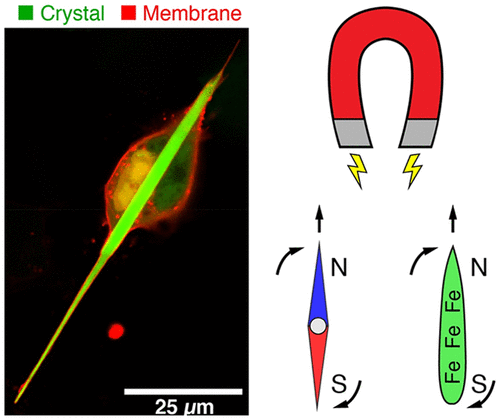
huge iron rods we grew inside human cells
Relevant publications
- Li, T. L.; Wang, Z.; You, H.; Ong, Q.; Varanasi, V. J.; Dong, M.; Lu, B.; Paşca, S. P.; Cui, B. Engineering a Genetically Encoded Magnetic Protein Crystal. Nano Letters 2019, 19 (10), 6955–6963. doi:10.1021/acs.nanolett.9b02266
Nanomaterials (2012-2016)
Working in the Tracy, Li, and Melechko labs at NC State University in high school, I created optically active nanomaterials for bioimaging applications, catalysts for biofuel generation, and scalable production methods for vertically-aligned carbon nanofibers used in drug delivery, respectively. I coauthored my first research paper, on the latter work, at age 14. I also spent the summer before college at RTI International developing stain-resistant textile coatings for a corporate client, using harmless silica nanoparticles instead of the industry standard "forever chemicals".
For my research work in high school, I was named a Semifinalist in the Intel Science Talent Search and a Regional Finalist in the now-defunct Siemens Competition.
Relevant publications
- Kodumagulla, A.; Varanasi, V.; Pearce, R. C.; Wu, W. C.; Hensley, D. K.; Tracy, J. B.; McKnight, T. E.; Melechko, A. V. Aerosynthesis: Growth of Vertically-Aligned Carbon Nanofibres with Air DC Plasma. Nanomaterials and Nanotechnology 2014, 4, 6. doi:10.5772/58449
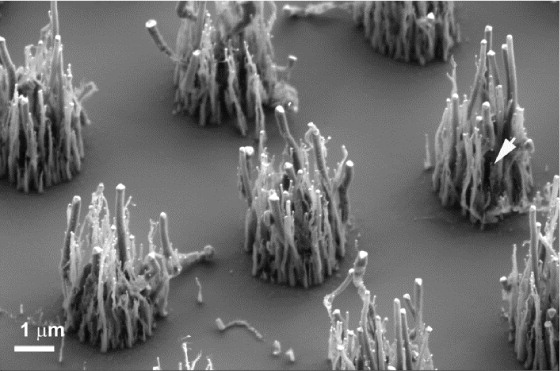
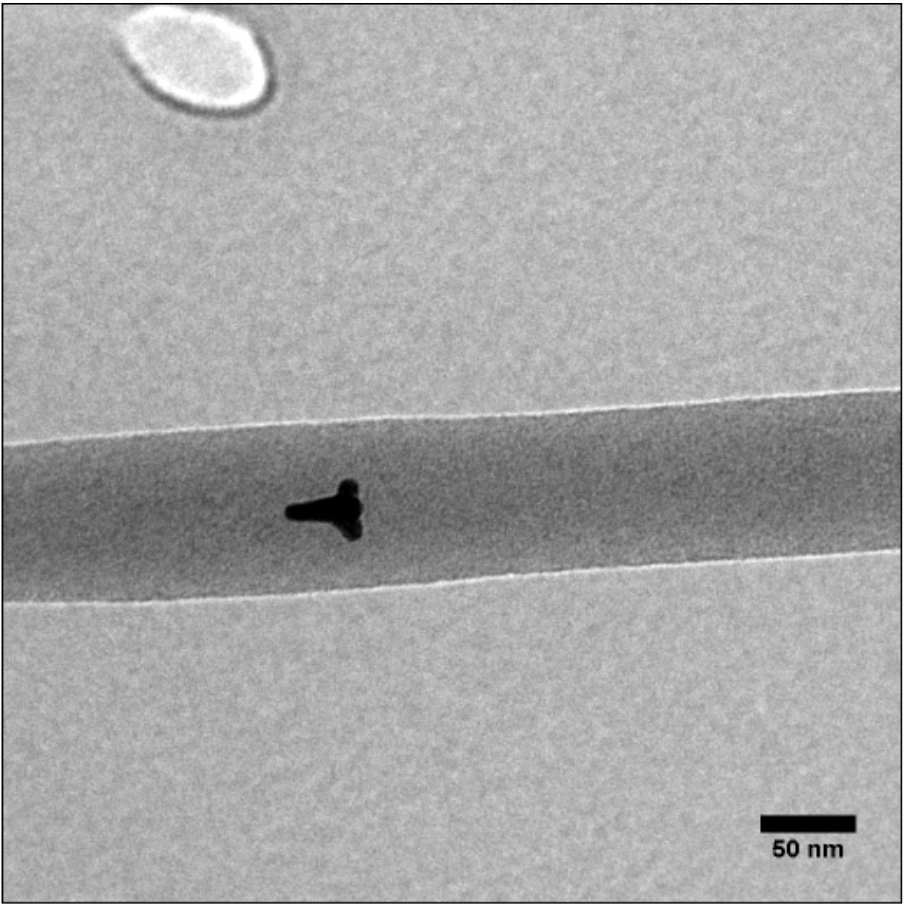
some nanomaterials I made: vertically aligned carbon nanofibers (left) and gold nanostars embedded in polymer nanofibers (right)